
The study, led by the Institute of Astrophysics of Andalusia (IAA-CSIC), provides a new way to understand the nature of dark matter
The work offers for the first time an estimate of the frequency with which dwarf galaxies exhibit stellar streams
Galaxies don’t grow in isolation. According to the standard model of galaxy formation, even the smallest ones—so-called dwarf galaxies—should be surrounded by even smaller satellite galaxies, which eventually merge with them. However, verifying this process with actual observations has been very difficult until now.
A new study led by the Institute of Astrophysics of Andalusia (IAA-CSIC) and published today in Astronomy & Astrophysics (A&A) has advanced this line of inquiry by identifying 17 cases of accretion features—possible mergers with lower-mass satellite galaxies—around dwarf galaxies. The finding confirms that these galaxies also grow through a process of galactic «cannibalism» and opens a new avenue for studying one of the great enigmas of cosmology: dark matter.
“We have provided for the first time an estimate of the frequency with which dwarf galaxies exhibit stellar streams,” notes Joanna D. Sakowska, researcher at the IAA-CSIC and lead author of the study.
WHEN ONE GALAXY “EATS” ANOTHER, IT LEAVES TRACES
When a large galaxy absorbs a smaller one, the merger doesn’t happen abruptly. Gravity gradually pulls and tears away stars from the satellite galaxy, which then scatter around the main galaxy, forming recognizable structures such as stellar streams, shells, or asymmetrical halos. These traces have been observed relatively frequently in massive galaxies like the Milky Way, but examples in dwarf galaxies were scarce.
In this work, the research team analyzed deep sky images and compiled the first systematic catalog of accretion remnants in dwarf galaxies, which includes one stellar stream, eleven shells, and eight asymmetric stellar halos. Of these, 17 are new discoveries.
“We know that these mergers should exist, but they are extremely difficult to detect in such small galaxies,” explains Sakowska (IAA-CSIC). “This work is a first glimpse that shows that dwarf galaxies also bear scars from their past.”
A NATURAL LABORATORY FOR STUDYING DARK MATTER
Dwarf galaxies are especially interesting because they are dominated by dark matter, an invisible substance that makes up most of the matter in the universe and whose nature remains unknown. The way these galaxies merge and the appearance of the remnants they leave behind are very sensitive to the properties and distribution of dark matter.
“Small differences in the nature of dark matter produce very different and observable results,” Sakowska points out. “Studying how many mergers there are and what their remnants are like allows us to learn about dark matter, even though we can’t observe it directly.” In this context, David Martínez Delgado, second author of the paper and researcher at CEFCA, adds that stellar streams are excellent tracers of the dark matter in the galaxies that host them. “In addition to their frequency, their shape reflects the ‘frozen’ orbit of their progenitor dwarf galaxy, which offers a unique opportunity to determine how much dark matter is needed to explain their motion”.
One of the study’s most significant findings is a stellar stream whose shape fits theoretical models, allowing researchers to either rule out or support certain types of dark matter. Furthermore, the work provides the first estimate of how frequently dwarf galaxies exhibit this type of structure.
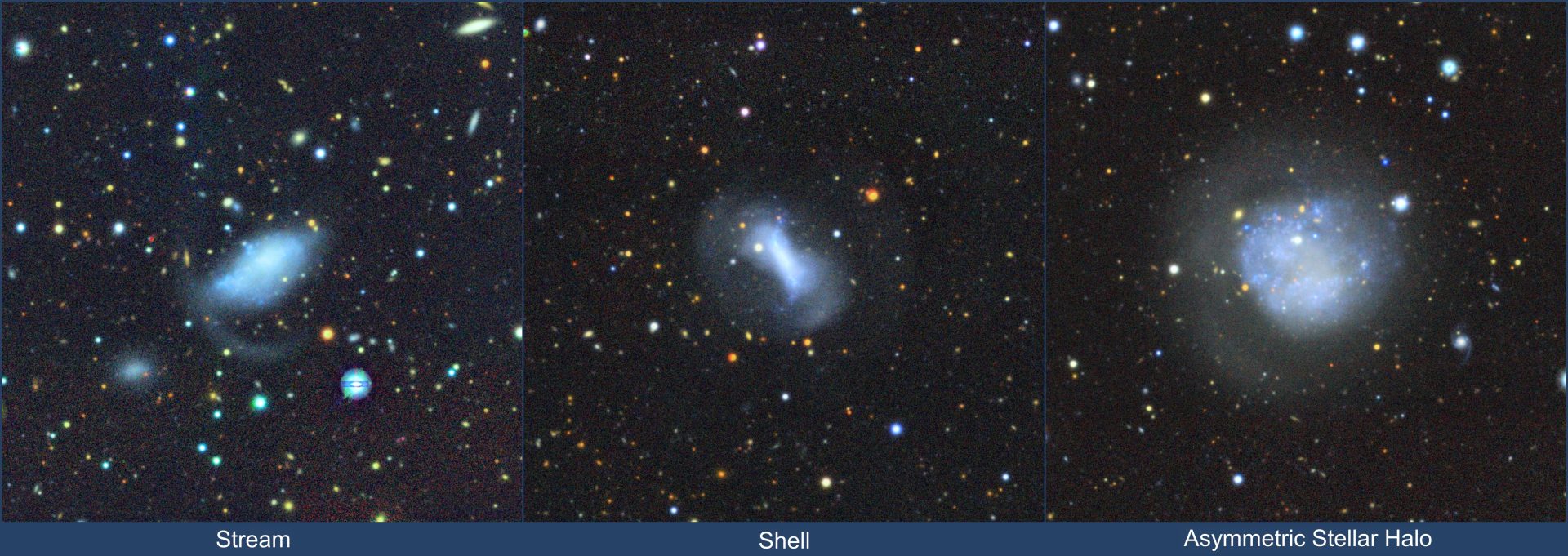
How galactic cannibalism manifests in dwarf galaxies: a stream, a shell, or an asymmetric stellar halo. Credits: Sakowska et al. 2026.
A PREVIEW OF WHAT’S TO COME
The study, led by the Institute of Astrophysics of Andalusia (IAA-CSIC), is part of the Stellar Stream Legacy Survey (SSLS), an international project whose objective is to build a large and homogeneous sample of stellar streams to compare observations and theory. To do this, the team visually inspected dwarf galaxies using data from the Legacy Imaging Survey , one of the deepest surveys of the sky.
The results highlight both the difficulty of detecting these features and the need to improve theoretical models of low-mass mergers. Even so, they provide new observational constraints on how the smallest galaxies in the universe grow.
“We have spectacular images of tiny galaxies ‘devouring’ even smaller ones,” Sakowska concludes. “This work is just a preview of what we will be able to see with future telescopes like LSST, which will allow us to detect even more subtle traces of galactic cannibalism. If the observations don’t match the predictions, it could be a sign that we need to revise our theories about galaxy formation or even about the very nature of dark matter.”
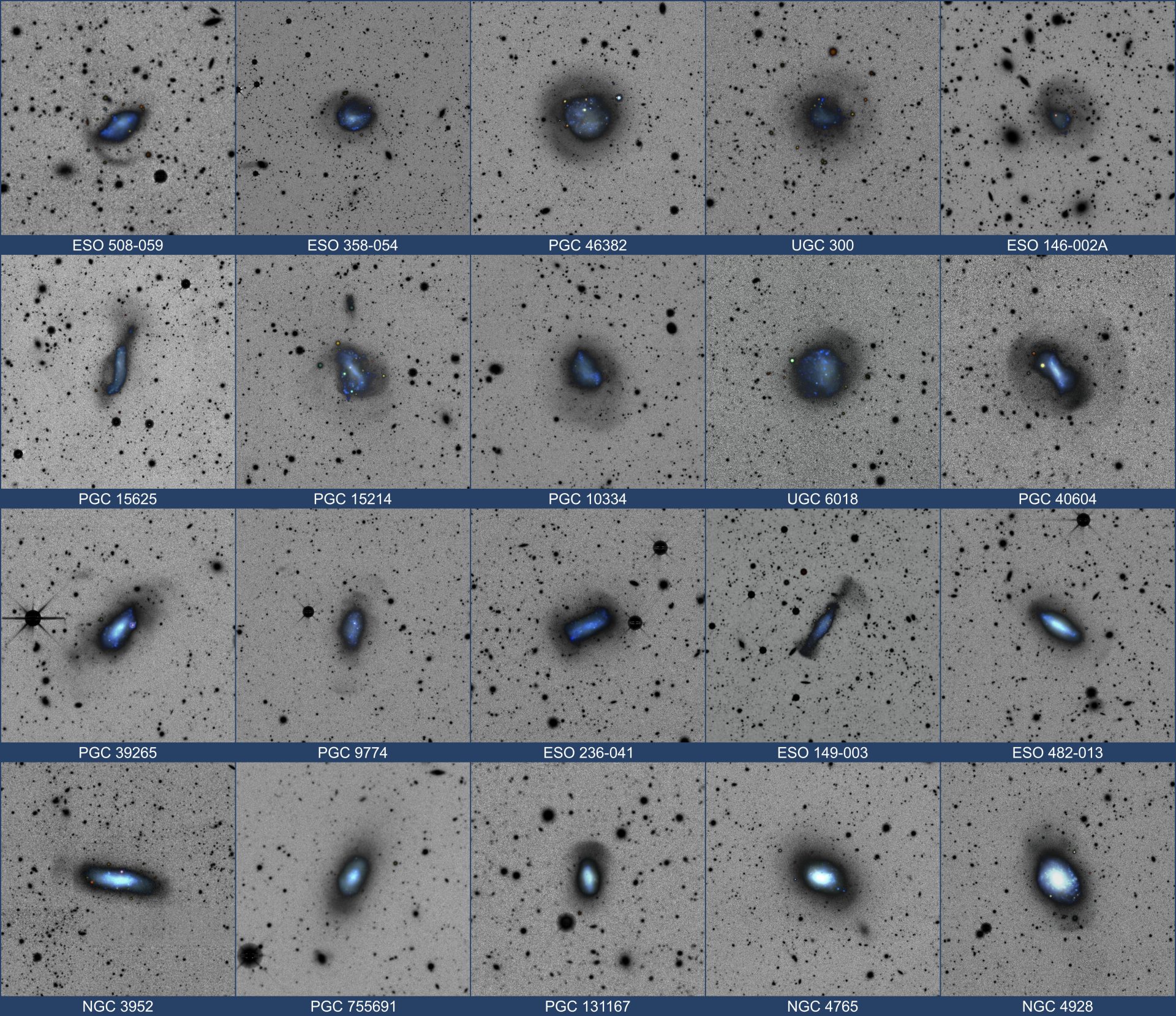
Twenty cases of accretion structures, including seventeen new discoveries. We found one stream, eight asymmetric stellar halos, and eleven shells. Credits: Sakowska et al. 2026.
Downloadable material
MORE INFO:
Joanna D. Sakowska – jsakowska@iaa.csic.es
Instituto de Astrofísica de Andalucía (IAA-CSIC)
Unidad de Cultura Científica y de la Innovación (UCC+I)
Amanda López Moreno – alm@iaa.es
Emilio García – garcia@iaa.es, 649 407 445 (vía WhatsApp)
Celia Navas – navas@iaa.es
https://www.iaa.csic.es