
A researcher from the Institute of Astrophysics of Andalusia (IAA-CSIC) has developed a new theoretical framework to describe the behavior of the interior of spherically symmetric black holes.
The work, published in Nature Communications, introduces a set of equations that allow overcoming the singularities predicted by general relativity
The theory of general relativity, formulated by Albert Einstein over a century ago, is the cornerstone of our understanding of gravity and the most extreme phenomena in the universe. However, these equations predict the existence of singularities: regions where the density and curvature of spacetime become infinite and the description they provide ceases to be valid. This limitation has spurred the search for new proposals capable of going beyond the original theory and addressing unresolved processes, such as the formation and evaporation of black holes.
In this context, the journal Nature Communications publishes today a paper by Raúl Carballo-Rubio, a researcher at the Institute of Astrophysics of Andalusia (IAA-CSIC), which proposes a new theoretical framework for analyzing previously inaccessible aspects of black hole physics. “My work presents a set of equations that establish new ‘rules’ to describe how the interior of spherically symmetric black holes can behave,” explains Carballo-Rubio. “While in general relativity these objects exhibit an incomplete structure, this new framework allows us to describe black holes without that limitation.”
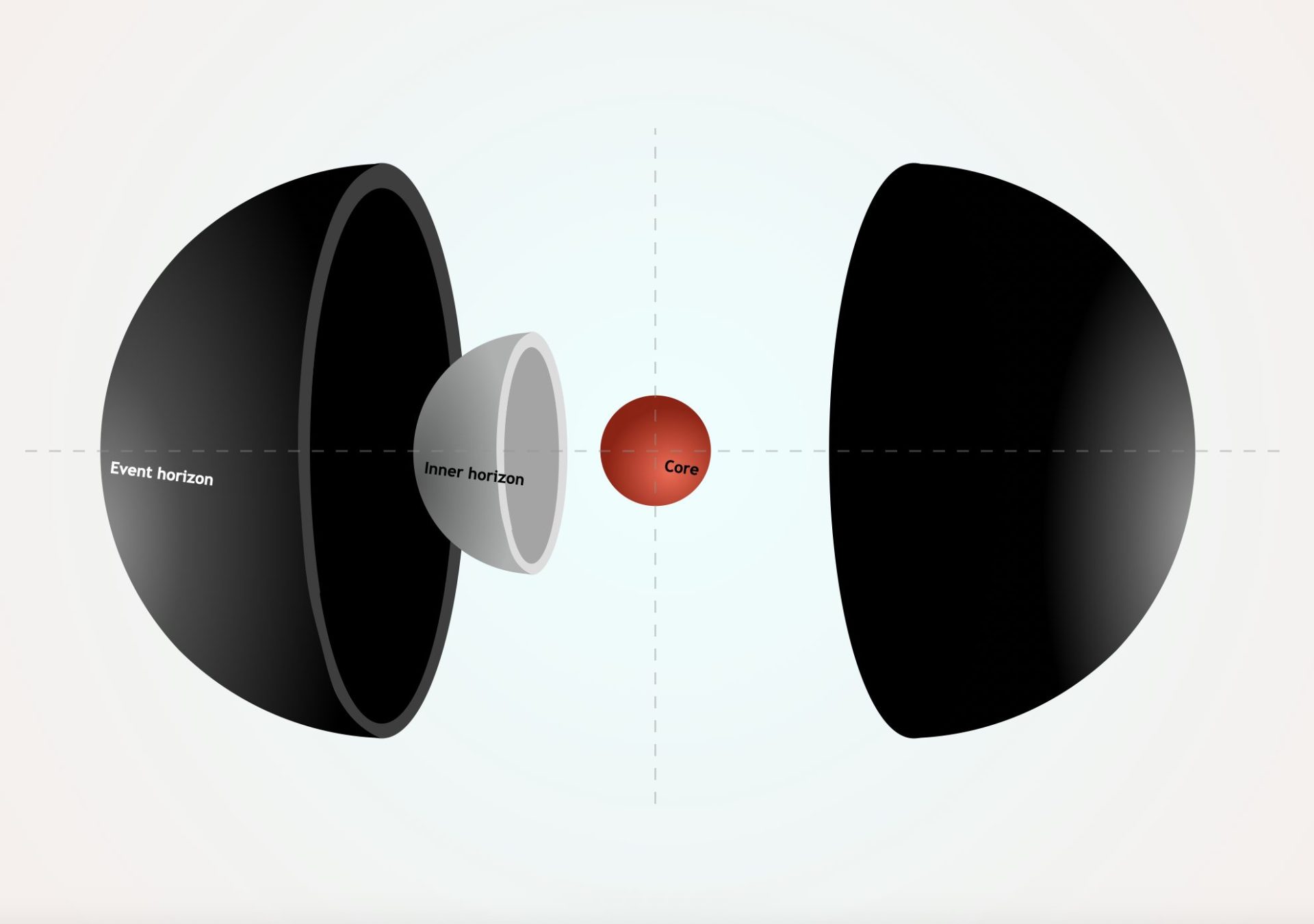
Diagram of the static structure of a spherically symmetric black hole. Credits: Raúl Carballo-Rubio (IAA-CSIC)
A MATHEMATICAL IDEALIZATION
Spherically symmetric black holes are a theoretical idealization: perfectly “round” objects, without rotation or deformation, whose properties depend solely on the distance from the center. In general relativity, the simplest example is the Schwarzschild solution, which describes a black hole with no angular momentum and no electric charge.
Although this model accurately reproduces what happens outside the event horizon, it inevitably leads to a central singularity. There, the curvature of spacetime becomes infinite, and the trajectories of particles and light cannot extend beyond a certain point. This is what is technically known as geodesic incompleteness. “The existence of singularities in Einstein’s theory does not allow us to construct a complete history for the formation and evaporation of a black hole,” notes Raúl Carballo-Rubio (IAA-CSIC).
The new framework proposed by the researcher from the Institute of Astrophysics of Andalusia introduces a set of equations that allows for the description of spherically symmetric black holes without this internal breakdown, opening the door to a coherent physical narrative from their formation to their possible evaporation. “This requires combining elements of classical and quantum field theory with the new equations I am developing,” he explains.
“The next step will be to analyze in detail the physical properties of these objects, both from a theoretical point of view —exploring the solutions of the equations— and through numerical simulations that allow us to study their behavior in different scenarios,” concludes Carballo-Rubio (IAA-CSIC).
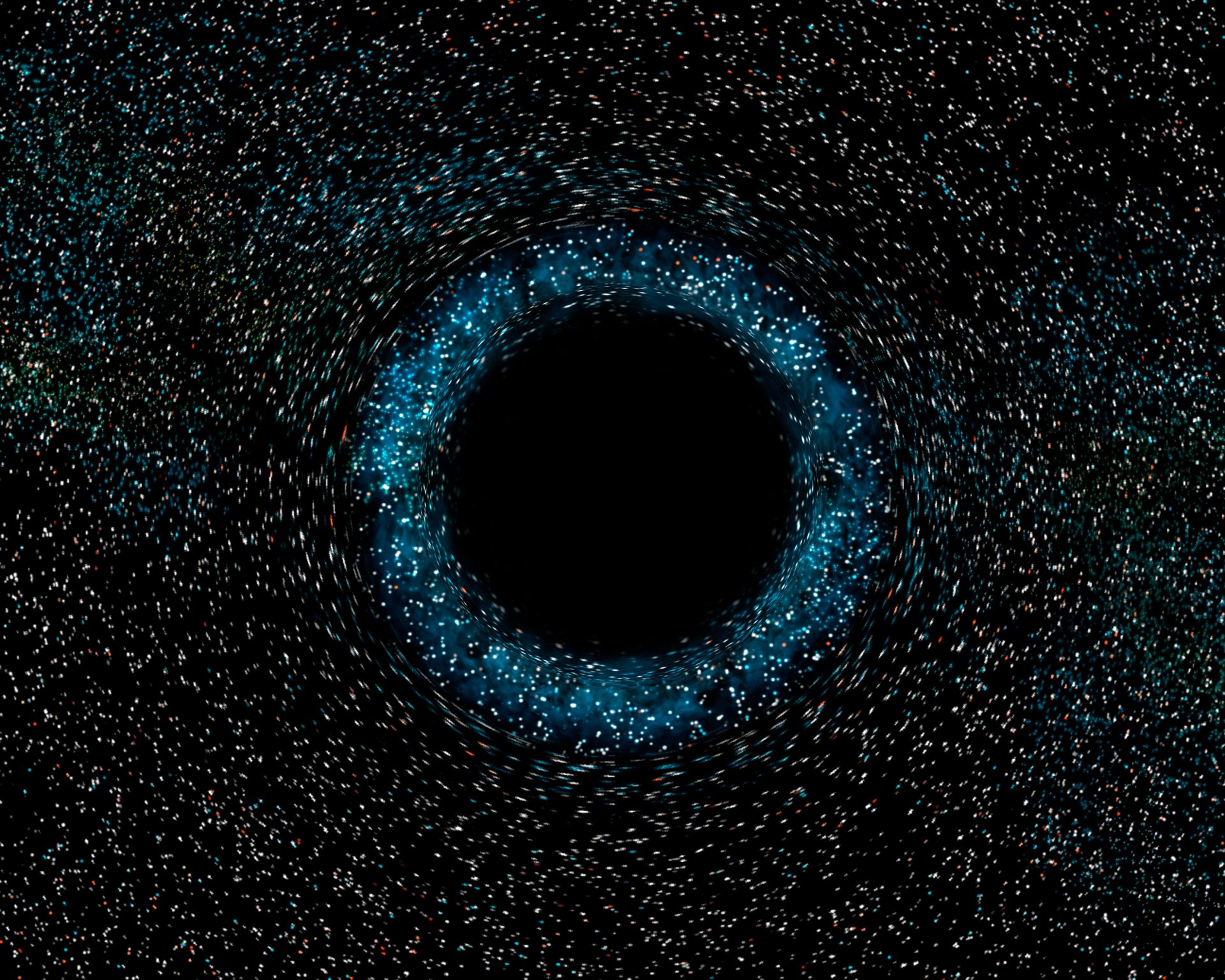
Artistic impression of a black hole. Credit: European Space Agency, NASA and Felix Mirabel (the French Atomic Energy Commission & the Institute for Astronomy and Space Physics/Conicet of Argentina)
Download material
Raúl Carballo-Rubio – raul.carballorubio@iaa.csic.es
Instituto de Astrofísica de Andalucía (IAA-CSIC)
Unidad de Cultura Científica y de la Innovación (UCC+I)
Amanda López Moreno – alm@iaa.es
Emilio García – garcia@iaa.es, 649 407 445 (vía WhatsApp)
Celia Navas – navas@iaa.es
https://www.iaa.csic.es