
The study, led by the Institute of Astrophysics of Andalusia (IAA-CSIC), analyzes the IRAS 18162−2048 region using near-infrared observations with the VLT and radio observations with the VLA and ALMA telescopes
The results reveal that IRS7, a previously understudied source, may be more evolved than the region’s main source, responsible for the iconic HH 80–81 jet
Located in the constellation Sagittarius, the IRAS 18162–2048 region is one of the most studied examples of massive star formation in our galaxy. It contains a massive central protostar, responsible for the iconic protostellar jet HH 80–81. The spectacular nature and energy of this system have captured the attention of the scientific community since its discovery in the 1980s, overshadowing other sources present in the region.
The Institute of Astrophysics of Andalusia (IAA-CSIC) has led a study, published today in Astronomy & Astrophysics (A&A), in which observations of this region have been made in both near infrared and radio, revealing evidence of a source of ionizing photons distinct from the main one: IRS7, also known as “static condensation” (SC), a young B2–B3 type star.
“The most significant aspect of our results is that they reveal that IRS7 may be more evolved than the primary source of IRAS 18162–2048, despite being less massive,” says Rubén Fedriani, a researcher at the IAA-CSIC and first author of the study. “This positions this historically understudied source as a key target for future observations with telescopes such as the James Webb Space Telescope or ALMA.”
A HISTORICALLY FORGOTTEN SOURCE
A study led by the Institute of Astrophysics of Andalusia (IAA-CSIC) has observed the IRAS 18162−2048 region in near infrared —capable of penetrating dust— with the VLT (Very Large Telescope) of the European Southern Observatory (ESO) in Chile, and in radio, through observations with the VLA (Very Large Array) interferometer and the ALMA (Atacama Large Millimeter Array ) radio telescope.
“This region is an excellent laboratory for studying the early stages of massive star formation, since, in addition to its central protostar, it is home to numerous lower-mass protostellar objects around it, whose evolutionary process could be altered by the presence of that central giant,” says Guillem Anglada, a researcher at the IAA-CSIC and a member of the team.
The observations, made at scales of a few thousand astronomical units, focus on the immediate vicinity of the region’s main source, the driving force behind the iconic HH 80–81 jet. This source remains completely invisible in the near-infrared down to at least 2.5 microns. Even the longest wavelengths in this range—the most effective at penetrating dust—fail to detect it, indicating that the surrounding material remains extremely dense and keeps it hidden.
However, these observations have allowed scientists to identify another source in the region that, although detected back in the 1990s, had gone unnoticed due to the brightness of the main source. This is IRS7, also known as «static condensation,» since, unlike the jets associated with HH 80–81—which reach speeds exceeding 1,000 kilometers per second—this source shows no appreciable movement.
“What we have observed in the infrared, both spectrally and through imaging, is the Brackett gamma line (Brγ), a hydrogen recombination line,” explains Fedriani (IAA-CSIC). “When this line appears, it is because hydrogen ionizes—loses electrons—and subsequently recombines, emitting a very characteristic radiation that corresponds to that wavelength.”
This signal provides direct evidence of hot, active gas in the vicinity of a young star. By analyzing the profile—shape and width—of the line, the team concludes that it is a newborn B2–B3 star: very hot, luminous, and relatively massive, though less so than the main source in the region. This result is supported by radio observations, which indicate less dust around this source, consistent with the expected emission of a newborn B2–B3 star at these wavelengths.
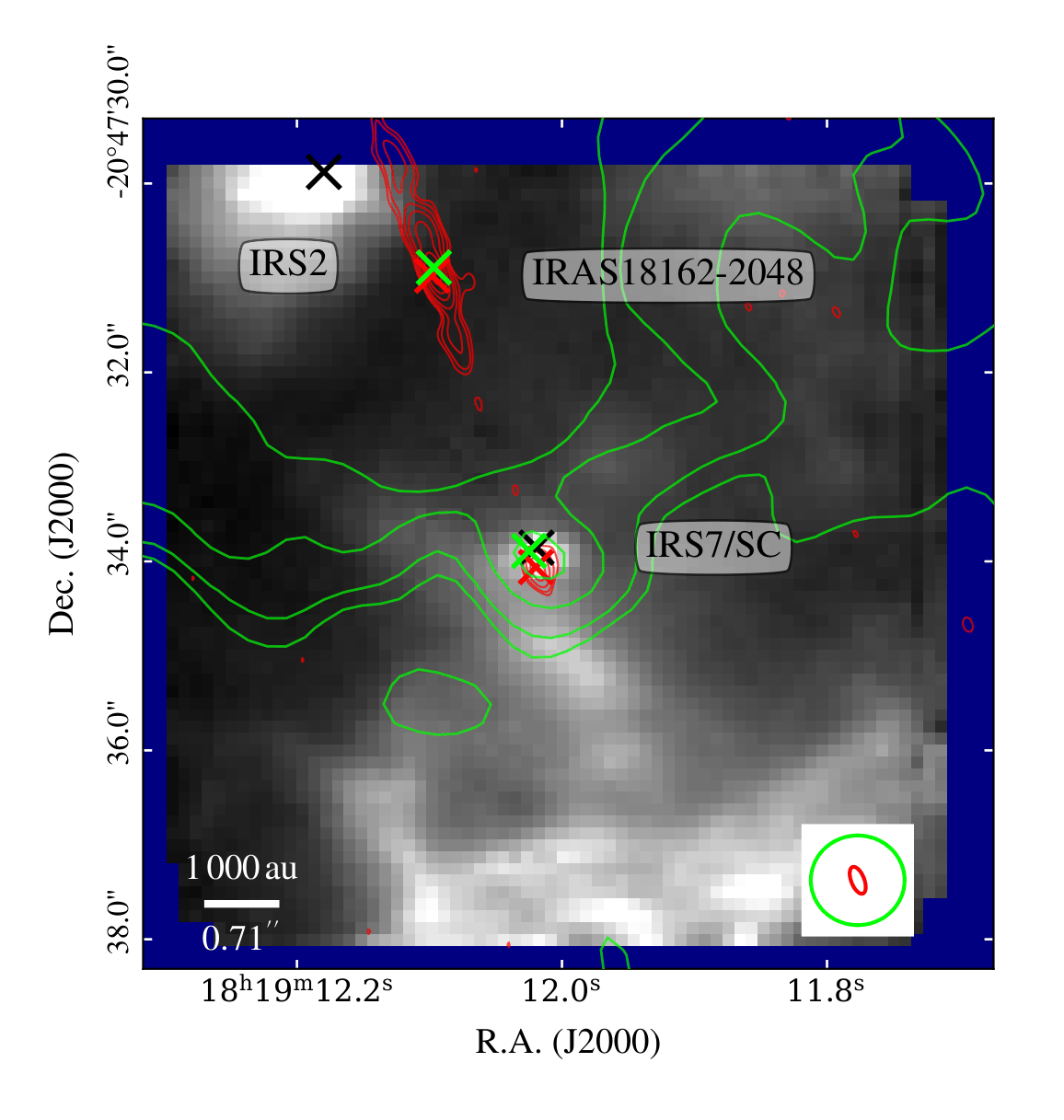
Multi-wavelength near-infrared image taken with the VLT (black and white background image) along with radio emissions from the VLA (red outlines) and ALMA (green outlines). Credits: Rubén Fedriani et al. (2026), A&A.
EVIDENCE OF GREATER EVOLUTION
The results also suggest that IRS7 may host an incipient H II region, that is, an area of ionized gas generated by the radiation of a young, hot star. Excited molecular hydrogen (H₂) has also been detected in its vicinity, likely due to photoionization from the source itself.
This finding is particularly relevant because it indicates that IRS7—along with its forming H II region—is at a more advanced evolutionary stage than the region’s main protostar, which has a mass more than twenty times that of the Sun. Taken together, these results suggest that the IRAS 18162–2048 region harbors a multigenerational stellar population, with objects at different stages of evolution.
“To confirm these conclusions, further observations with telescopes such as the James Webb Space Telescope will be necessary, which will allow us to study the region in greater detail at different wavelengths, especially in the infrared, and thus reveal the complex structure that remains hidden behind the dust,” concludes Rubén Fedriani (IAA-CSIC).
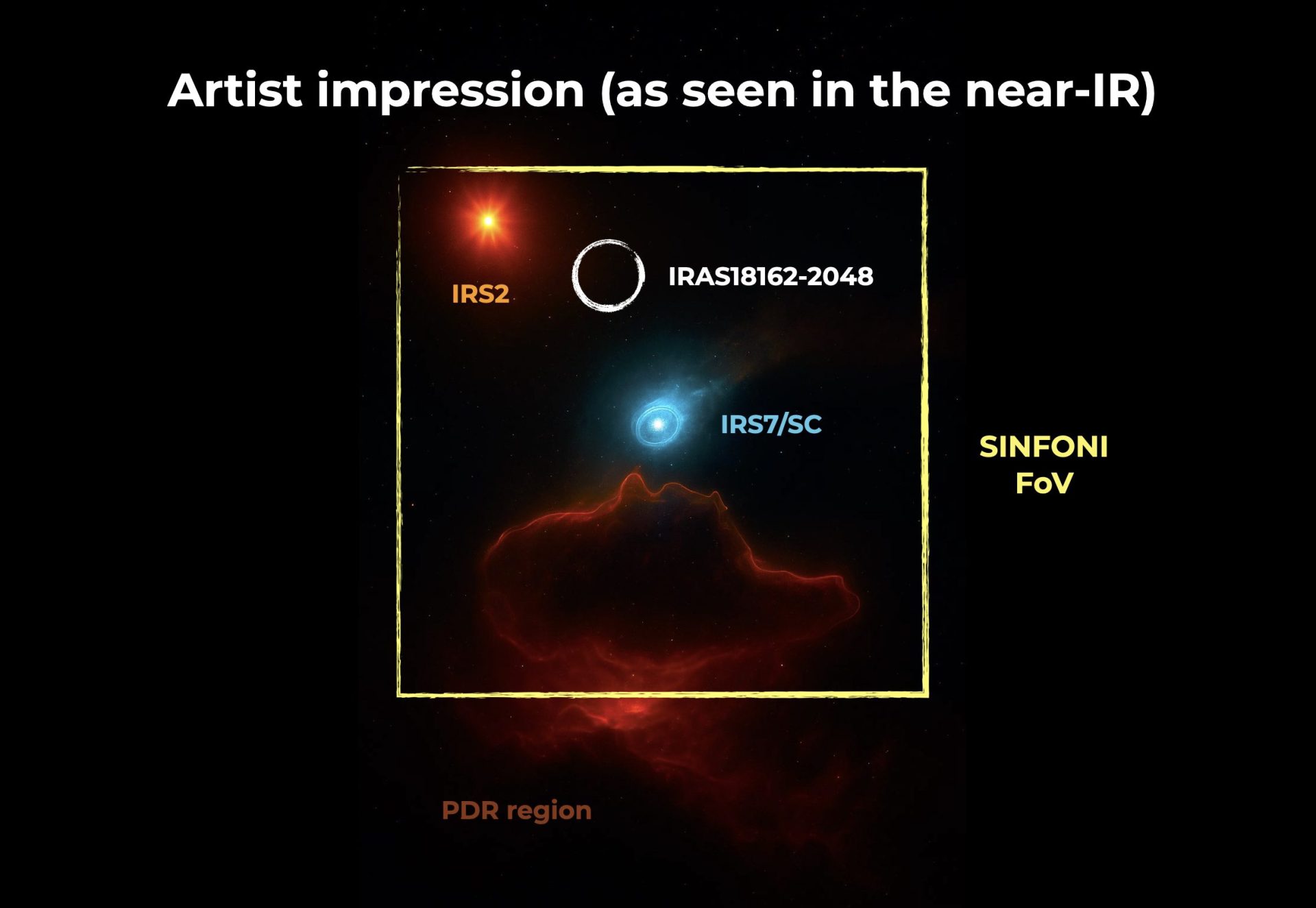
Artist’s impression of the IRAS18162-2048 region as seen in the near-infrared. The main source located inside the white circle is invisible at these wavelengths. The IRS7/SC source is bright in the infrared, especially in the hydrogen recombination line Brγ. Credits: Rubén Fedriani, AI-generated with chatGPT based on a hand-drawn draft.
Downloadable Material
Rubén Fedriani – fedriani@iaa.es
Instituto de Astrofísica de Andalucía (IAA-CSIC)
Unidad de Cultura Científica y de la Innovación (UCC+I)
Amanda López Moreno – alm@iaa.es
Emilio García – garcia@iaa.es, 649 407 445 (vía WhatsApp)
Celia Navas – navas@iaa.es
https://www.iaa.csic.es